
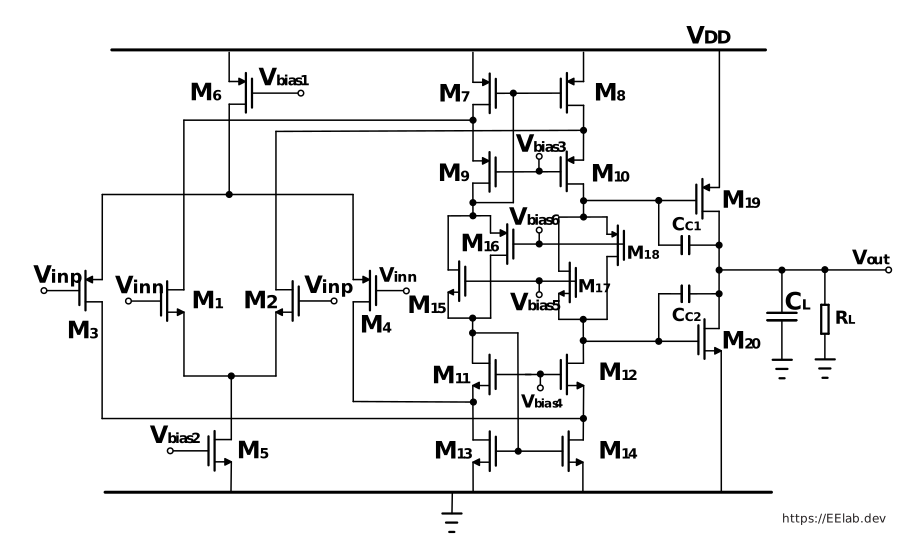
The design of Analog and Mixed-Signal (AMS) integrated circuits (ICs) often involves significant manual effort, especially during the transistor sizing process. While Machine Learning techniques in Electronic Design Automation (EDA) have shown promise in reducing complexity and minimizing human intervention, they still face challenges such as numerous iterations and a lack of knowledge about AMS circuit design. Recently, Large Language Models (LLMs) have demonstrated significant potential across various fields, showing a certain level of knowledge in circuit design and indicating their potential to automate the transistor sizing process. In this work, we propose an LLM-based AI agent for AMS circuit design to assist in the sizing process. By integrating LLMs with external circuit simulation tools and data analysis functions and employing prompt engineering strategies, the agent successfully optimized multiple circuits to achieve target performance metrics. We evaluated the performance of different LLMs to assess their applicability and optimization effectiveness across seven basic circuits, and selected the best-performing model Claude 3.5 Sonnet for further exploration on an operational amplifier, with complementary input stage and class AB output stage. This circuit was evaluated against nine performance metrics, and we conducted experiments under three distinct performance requirement groups. A success rate of up to 60% was achieved for reaching the target requirements. Overall, this work demonstrates the potential of LLMs to improve AMS circuit design.
Find out more at EEsizer
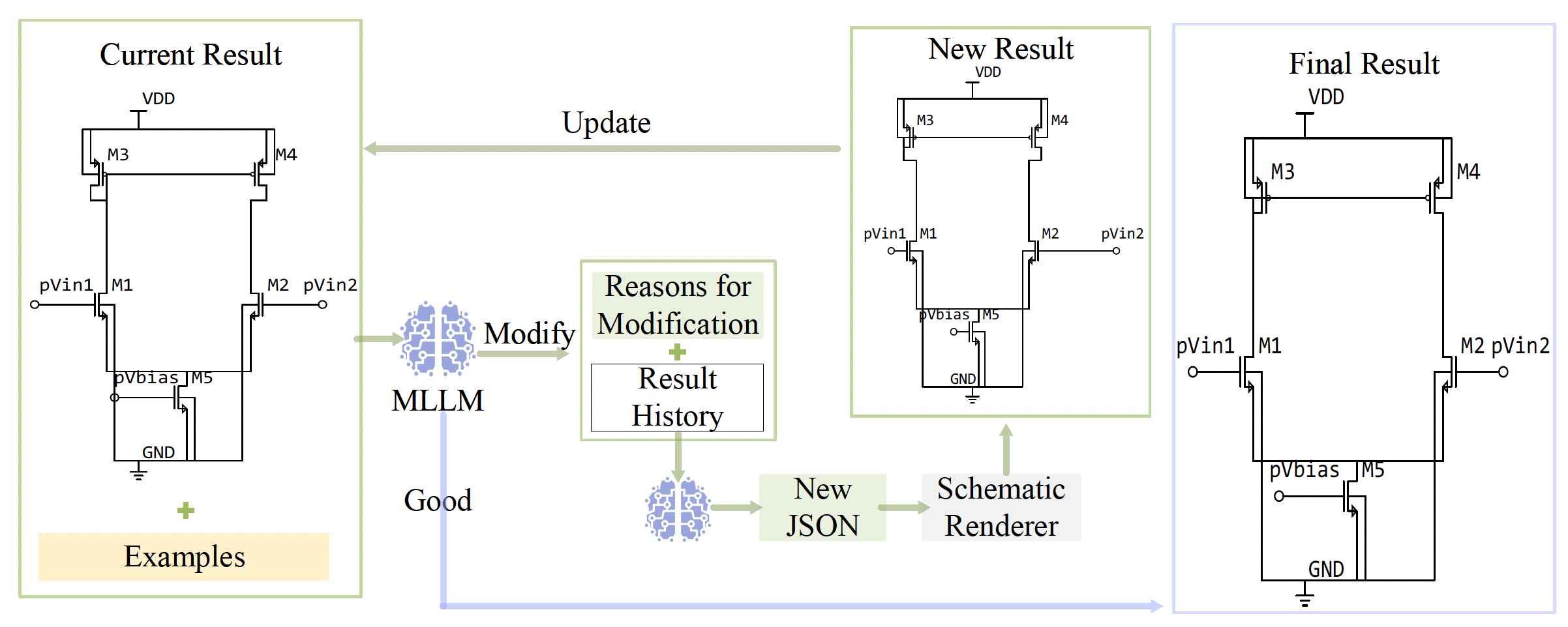
Circuit schematics play a crucial role in analog integrated circuit design, serving as the primary medium for human understanding and verification of circuit functionality. While recent large language model (LLM)-based approaches have shown promise in circuit topology generation and device sizing, most rely solely on textual representations such as SPICE netlists, which lack visual interpretability for circuit designers. To address this limitation, we propose EEschematic, an AI agent for automatic analog schematic generation based on a Multimodal Large Language Model (MLLM). EEschematic integrates textual, visual, and symbolic modalities to translate SPICE netlists into schematic diagrams represented in a human-editable format. The framework uses six analog substructure examples for few-shot placement and a Visual Chain-of-Thought (VCoT) strategy to iteratively refine placement and wiring, enhancing schematic clarity and symmetry. Experimental results on representative analog circuits, including a CMOS inverter, a five-transistor operational transconductance amplifier (5T-OTA), and a telescopic cascode amplifier, demonstrate that EEschematic produces schematics with high visual quality and structural correctness.
Find out more at EEschematic